
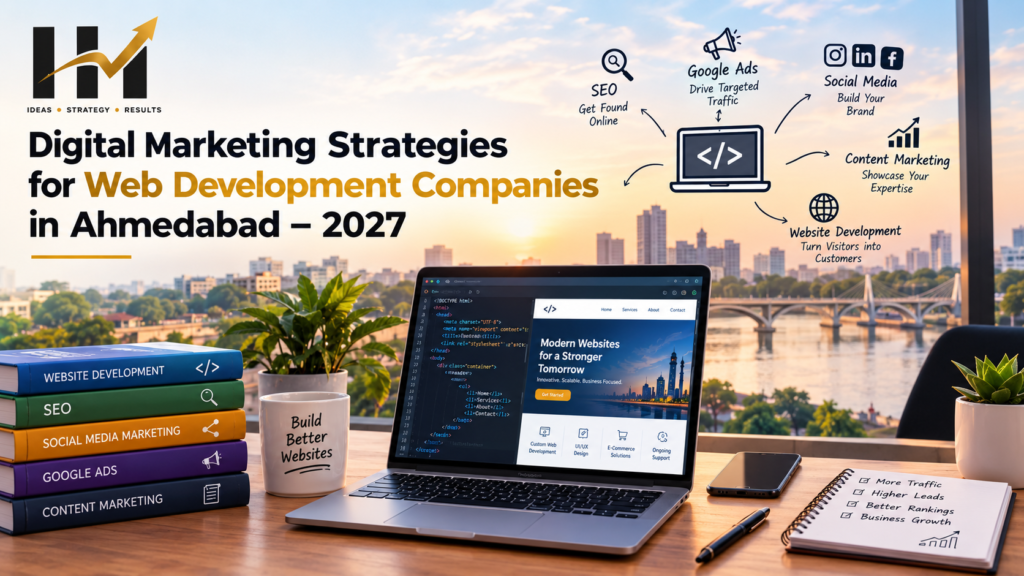
A web development company in Ahmedabad needs more than a technically strong website to consistently generate enquiries in 2027. The company also needs a digital marketing system that helps potential customers discover the business, understand its capabilities, evaluate its credibility and take action.
The buying process for website development is rarely as simple as someone searching for a developer and immediately making a purchase. A business owner may first search for a website developer, compare several agencies, look at portfolios, investigate technologies, read reviews, compare pricing, examine previous projects and then contact two or three companies, including a Digital Marketing Agency in Ahmedabad, before making a decision.
This makes digital marketing particularly important for web development companies. Search engine optimization can capture people researching website solutions. Local SEO can strengthen visibility for Ahmedabad-related searches. Google Ads can reach users already searching with commercial intent. Portfolio pages can provide proof of capability. Case studies can reduce uncertainty. LinkedIn and social content can demonstrate expertise. Conversion optimization can turn website visits into qualified enquiries.
For 2027, the most effective approach is therefore not to rely on one channel. It is to create a connected customer journey:
Search visibility → Relevant landing page → Trust and proof → Enquiry → Qualification → Proposal → Customer
Google’s current guidance also makes an important distinction between creating useful content and creating content simply to manipulate search visibility. Content should provide genuine value, while keyword stuffing, scaled low-value content and other manipulative practices can violate Google’s spam policies.
For Ahmedabad web development companies, this creates an opportunity to build a website that is not merely an online brochure, but a searchable, credible and conversion-focused sales asset.
How Do Businesses Choose a Web Development Company in Ahmedabad?
Businesses choosing a web development company generally evaluate a combination of capability, relevance, credibility, communication, project fit and expected value. The exact decision process varies by business size and project complexity, but most prospects want answers to similar questions before committing.
The first question is usually whether the company can actually build what they need. A business looking for a basic corporate website has different requirements from an e-commerce retailer, SaaS startup, manufacturer requiring a dealer portal or organization needing a custom web application. Therefore, a development company should not simply list technologies. It should demonstrate how those technologies solve different business requirements.
The second consideration is evidence. Prospects often look at portfolios, case studies, reviews and examples of previous work. A company that says it provides e-commerce development becomes more credible when it can demonstrate relevant e-commerce projects and explain the functionality involved.
The third consideration is process. Buyers want to know what happens after the enquiry. How are requirements collected? Who approves designs? How many revision rounds are included? How is content handled? What happens during testing? Who manages hosting and deployment? What support is available after launch?
What should a business evaluate?
Evaluation area | Questions a prospect may ask |
Experience | Have you built websites similar to mine? |
Technology | Which platform is appropriate for my requirements? |
Design | Can you create a professional responsive interface? |
Functionality | Can you handle integrations and custom features? |
SEO | Will the website have a technically sound structure? |
Performance | How will speed and mobile usability be handled? |
Process | What happens from discovery to launch? |
Support | What happens after the website goes live? |
Pricing | What is included in the project scope? |
Trust | Can I verify previous work and client feedback? |
This means an Ahmedabad web development company’s website should be designed around decision-making information, not just promotional statements, while incorporating Search Engine Optimization to help potential clients discover and evaluate the company online.
For example, a headline such as “We Create Powerful Digital Experiences” communicates very little. A more useful statement could explain that the company develops responsive business websites, e-commerce stores and custom web applications for Ahmedabad businesses.
The website should also make it easy to move from research to action. A prospect who has finished evaluating the service should not have to search for a contact option.
The broader lesson is that SEO and conversion optimization are connected. Ranking for a commercial query is only the beginning. The page must then answer the questions that caused the visitor to search in the first place.
Which SEO Keywords Should Ahmedabad Web Development Companies Target?
A web development company should build its SEO strategy around search intent and topic clusters, not simply collect hundreds of keywords and repeat them throughout the website.
Your supplied keyword research includes broad terms such as “web dev company,” “website developer,” “website developers,” “website development company,” “web programming company,” “best website development company,” “Shopify web development” and “ecommerce app development company.” These can be useful research inputs, but the provided search-volume figures should not be published as independently verified market statistics without confirming them through a current keyword-data source.
A stronger strategy divides keywords according to what the searcher is trying to accomplish.
Commercial keywords
These users are potentially looking for a provider:
- website development company
- website developer
- web development agency
- website development services
- website development company Ahmedabad
- website developer Ahmedabad
Platform-specific keywords
These users already have a technology direction:
- WordPress developer
- Shopify web development
- WooCommerce development
- Shopify website developer
- WordPress website development
Solution-specific keywords
These focus on business requirements:
- e-commerce website development
- custom web development
- web application development
- website redesign
- website maintenance
- responsive web design
Informational keywords
These users need education before choosing a provider:
- how much does website development cost
- how long does it take to build a website
- WordPress vs custom website
- Shopify vs WooCommerce
- what should I look for in a web development company
- does website development include SEO
This creates a logical website architecture.
Keyword intent | Recommended destination |
Website development company | Main service page |
Website development Ahmedabad | Local service page |
WordPress development | WordPress service page |
Shopify development | Shopify service page |
E-commerce development | E-commerce service page |
Web application development | Application-development page |
Website redesign | Redesign page |
Website maintenance | Maintenance page |
Website cost | Educational guide |
Platform comparisons | Comparison articles |
The company should also avoid creating dozens of pages that differ only by changing “Ahmedabad” to another city. Such pages need genuine local value; otherwise they risk becoming repetitive location-targeted content rather than useful resources.
Keyword placement should be natural across:
- H1
- H2/H3 where relevant
- Introduction
- Body copy
- Image alt text where descriptive
- Internal-link anchors
- Title tag
- Meta description
- URL
- Structured data where appropriate
The goal is not to make the primary keyword appear a fixed number of times. Google explicitly identifies keyword stuffing as spam, so an arbitrary keyword-density target should never override readability or usefulness.
A strong Ahmedabad SEO strategy therefore builds semantic coverage around website development while allowing each page to serve a distinct search intent.
How Can Local SEO Help a Web Development Company Win Ahmedabad Searches?
Local SEO can help an Ahmedabad web development company become more discoverable when prospective customers use location-based searches or search for nearby service providers.
Google explains that local results are primarily influenced by relevance, distance and prominence. Google also recommends maintaining complete and accurate Business Profile information so that the business can be matched with relevant local searches.
For a web development company, local SEO should therefore begin with accurate business information rather than simply adding “Ahmedabad” repeatedly to website copy.
Build a complete Google Business Profile
The profile should accurately represent:
- Business name
- Category
- Address or service-area information where applicable
- Phone number
- Website
- Business hours
- Services
- Photos
- Reviews
- Other relevant business information
Google states that complete and accurate information makes a Business Profile more likely to appear for relevant local searches.
Create genuine Ahmedabad relevance
The website should explain why the company serves Ahmedabad businesses and what types of businesses it works with.
For example, useful local content could cover:
- Website development for Ahmedabad SMEs
- E-commerce websites for Gujarat retailers
- Website redesign for established Ahmedabad businesses
- Website requirements for local manufacturers
- Business website planning for Ahmedabad startups
- Website development considerations for local professional services
The difference between useful local SEO and keyword stuffing is information value.
A paragraph that says “We are the best website development company in Ahmedabad and provide website development services in Ahmedabad” adds almost nothing.
A page explaining how a local manufacturer may need product catalogues, enquiry forms, dealer information, multilingual content, downloadable brochures and CRM integration provides actual value.
Reviews can support local trust
Relevant local business directories, associations, industry publications, events, partnerships and genuine mentions can contribute to a company’s broader online presence.
The company should prioritize relevance rather than purchasing large numbers of low-quality links.
Local SEO should therefore combine:
Accurate Business Profile + Useful local website content + Genuine reviews + Relevant online presence + Strong service pages
Importantly, local SEO cannot guarantee a specific Maps position. Google states that local ranking is determined by its systems and that businesses cannot simply pay Google to receive a better local ranking.
The objective should be to make the company more relevant, understandable and trustworthy for the searches it genuinely serves.
What Should a High-Converting Web Development Service Page Include?
A high-converting web development service page should answer the visitor’s main questions quickly and then provide enough evidence for the visitor to make an informed enquiry.
The first screen should make four things clear:
What service is offered? Who is it for? What problem does it solve? What should the visitor do next?
A strong H1 might be:
Website Development Company in Ahmedabad for Business-Focused Websites
The introduction can then explain the actual service instead of using vague phrases such as “next-generation digital transformation.”
Recommended structure
- Service overview
Explain what the company develops and who the service is intended for.
- Business problems
Explain problems such as:
- Outdated website
- Poor mobile experience
- Difficult navigation
- Low enquiry conversion
- Slow performance
- Poor content management
- Limited e-commerce functionality
- Lack of integrations
- Development capabilities
Depending on actual services, this may include:
- Responsive website development
- WordPress development
- Shopify development
- WooCommerce
- Custom web applications
- API integration
- Payment gateway integration
- CMS development
- Website redesign
- Maintenance
- Process
Explain:
Discovery → Planning → Wireframes → UI Design → Development → Testing → Launch → Support
- Portfolio
Show actual work.
- Case studies
Explain project requirements and implementation.
- Technology
Explain technology according to project requirements rather than dumping a long list of programming languages.
- SEO and performance
Explain how development supports technical SEO and usability.
- FAQs
Answer genuine customer concerns.
- CTA
Use an action aligned with the visitor’s intent:
- Request a Website Quote
- Discuss Your Website Project
- Get a Development Consultation
Google Ads guidance reinforces the importance of making the landing page relevant to the ad, keyword and expected action. Google also recommends useful, original landing-page content and easy navigation.
This is useful even for organic traffic. Someone arriving from Google should immediately understand that they are on the right page.
Add trust near decision points
Instead of putting every testimonial at the bottom, place relevant proof close to the claims it supports.
For example:
E-commerce Development
→ Brief explanation
→ E-commerce portfolio
→ Relevant case study
→ Client feedback, if genuine
→ CTA
This creates a logical progression from claim → evidence → action.
The service page should ultimately function like a salesperson who answers the prospect’s most important questions without making unsupported promises.
How Can Google Ads Capture High-Intent Website Development Searches?
Google Search Ads can be particularly useful for web development companies because users often search directly for services when they have an active requirement.
However, the campaign should be built around intent and landing-page relevance, not simply maximum traffic.
Consider these searches:
- “website developer Ahmedabad”
- “website development company Ahmedabad”
- “Shopify developer Ahmedabad”
- “ecommerce website development company”
- “WordPress developer near me”
These searches can represent different requirements.
A campaign should therefore separate major service themes where appropriate.
Example campaign structure
Campaign | Search theme | Landing page |
Website Development | Business website | Website development page |
E-commerce | Online store | E-commerce page |
Shopify | Shopify services | Shopify page |
WordPress | WordPress services | WordPress page |
Redesign | Website redesign | Redesign page |
Custom Development | Web applications | Custom development page |
Google explains that ad relevance, expected click-through rate and landing-page experience are components used in Quality Score.
That means the relationship between the search, advertisement and landing page matters.
For example:
Search: Shopify website development
Ad: Shopify Website Development | Custom Store Design | Request a Consultation
Landing page: Shopify Development Services
The visitor should immediately find information about Shopify development.
Sending that person to a generic homepage creates unnecessary friction.
Build negative-keyword controls
Depending on the company’s service model, irrelevant searches might include:
- Free website builder
- Website development course
- Web developer jobs
- Website development tutorial
- Learn web development
The exact exclusions should be based on actual search-term data rather than assumptions.
Google’s keyword-matching system has evolved beyond purely exact word matching and can use the meaning and context of searches.
Therefore, search-term analysis remains important.
Measure the right conversions
Possible conversion actions include:
- Contact form
- Phone call
- WhatsApp enquiry
- Quote request
- Consultation
- Project brief submission
But the company should go one step further and identify which enquiries become qualified opportunities.
For example:
100 clicks → 12 enquiries → 6 qualified leads → 2 proposals → 1 customer
This is more useful than simply reporting that the campaign generated 12 leads.
Google also recommends looking at conversion and engagement metrics alongside Quality Score rather than treating Quality Score as the sole performance measure.
The best Google Ads strategy for a web development company is therefore search intent + relevant ad + relevant landing page + accurate conversion tracking + qualified-lead analysis.
How Can Portfolio Pages and Case Studies Generate Better Web Development Leads?
For a web development company, the portfolio is one of the most important trust-building assets because website development is an experience-based purchase.
Potential customers want evidence that the agency can deliver.
A portfolio should therefore do more than display screenshots.
A screenshot tells the visitor what the website looks like.
A case study explains why it was built that way and what the project involved.
A strong case study can include
Client context
Explain the business type and relevant project background.
Business challenge
For example:
- Existing website was outdated
- Mobile experience needed improvement
- Product catalogue required restructuring
- Online payments were required
- Customer enquiries needed better organization
- Website needed integration with another system
Requirements
Explain the functional requirements.
Solution
Describe the actual design and development approach.
Technology
Mention the technologies genuinely used.
UX considerations
Explain navigation, mobile usability, forms, checkout or information architecture where relevant.
SEO considerations
Discuss technical structure, page hierarchy, performance or other relevant work if it was actually part of the project.
Outcome
Only publish measurable outcomes when they can be verified and when the company has permission to disclose them.
Example
Instead of:
“We built a modern website for an Ahmedabad business.”
Use:
“The project involved redesigning the company’s corporate website, restructuring its service information, improving mobile navigation and creating dedicated enquiry paths for key services.”
This provides substantially more information.
Organize the portfolio strategically
Useful categories can include:
- Business websites
- E-commerce
- WordPress
- Shopify
- Custom applications
- Healthcare
- Education
- Real estate
- Manufacturing
- Professional services
This allows a prospect to find relevant examples quickly.
Connect case studies to service pages
For example:
E-commerce Development Page
→ Shopify project
→ Shopify case study
→ Shopify development enquiry CTA
This creates a logical internal-linking structure and helps prospects move from service information to proof.
The same approach can be used for WordPress, custom web applications and website redesign.
A portfolio should also avoid claiming projects that the company did not actually complete or exaggerating the company’s role. Authenticity is particularly important for E-E-A-T because the portfolio is effectively evidence of experience.
Google’s spam policies emphasize the importance of avoiding unoriginal content and practices designed primarily to manipulate search systems.
For a development company, original screenshots, genuine project descriptions and verifiable implementation details provide stronger value than generic portfolio copy.
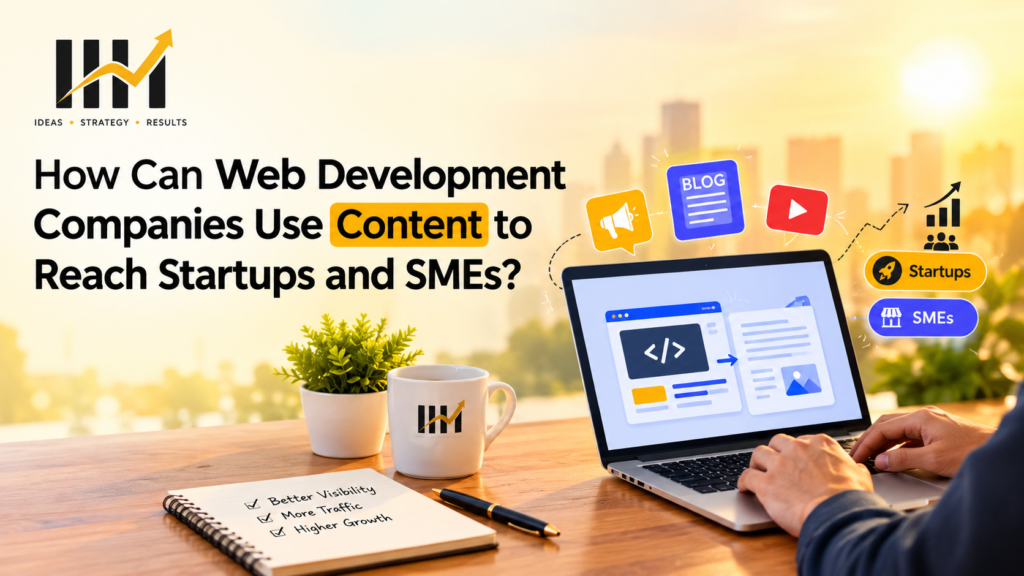
How Can Web Development Companies Use Content to Reach Startups and SMEs?
Content marketing allows a web development company to reach potential customers before they are ready to request a quote.
A startup founder may not initially search for an agency. They might first search:
- How much does a business website cost?
- What pages should a business website have?
- Should I use WordPress or custom development?
- Is Shopify suitable for my business?
- How long does website development take?
- What does a professional website include?
- How much does an e-commerce website cost?
- What should I ask a website developer?
Each question represents a potential content opportunity.
Create content for different stages
Awareness content
Examples:
- Business website checklist
- Website mistakes businesses should avoid
- Website launch checklist
- Website planning guide
Evaluation content
Examples:
- WordPress vs custom development
- Shopify vs WooCommerce
- Website agency vs freelancer
- Website redesign checklist
- Questions to ask a website developer
Commercial content
Examples:
- Website development services
- E-commerce development
- Shopify development
- WordPress development
- Custom web application development
Post-launch content
Examples:
- Website maintenance checklist
- Website security checklist
- Website performance guide
- SEO after website launch
- Website content update process
Make content industry-specific
A useful opportunity for Ahmedabad agencies is to develop content around business types.
For example:
Website requirements for manufacturers
could discuss:
- Product catalogue
- Product specifications
- Downloadable brochures
- Dealer/distributor information
- Enquiry forms
- Location pages
- Lead routing
- CRM integration
Similarly:
Website requirements for real-estate businesses
could discuss:
- Project pages
- Property galleries
- Location information
- Lead forms
- Brochures
- Floor plans
- Enquiry tracking
This type of content demonstrates subject understanding while naturally introducing relevant development services.
Avoid content volume for its own sake
Publishing 100 weak articles does not automatically create a strong SEO strategy.
Google’s spam policies specifically address scaled content created primarily to manipulate rankings.
A better approach is to publish fewer, deeper resources containing:
- Original examples
- Screenshots
- Practical checklists
- Comparisons
- Decision frameworks
- Clear definitions
- Real project observations
- Verified data when available
Each article should also connect naturally to an appropriate service page.
For example:
Article: “WordPress vs Custom Website”
→ Internal link: WordPress Development
→ Internal link: Custom Web Development
→ CTA: Discuss Your Website Requirements
This creates a content-to-service funnel without forcing promotional messaging into every paragraph.
How Should E-Commerce, WordPress and Custom Web Development Services Be Positioned?
WordPress, Shopify, e-commerce and custom web development should not be presented as four versions of the same service.
They solve different business problems.
WordPress development
WordPress can be positioned for businesses that need a flexible content-management system and a website that internal teams can manage.
Potential use cases include:
- Corporate websites
- Professional services
- Blogs
- Educational websites
- Content-heavy websites
- Business websites
Shopify development
Shopify can be positioned around hosted e-commerce requirements.
Potential considerations include:
- Product catalogue
- Store design
- Checkout
- Payment integrations
- Shipping
- Product management
- E-commerce apps
- Store customization
WooCommerce
WooCommerce can be relevant when a business wants e-commerce functionality within the WordPress ecosystem.
Custom development
Custom development is more appropriate when the project has requirements that cannot be efficiently addressed through a standard platform.
Examples may include:
- Custom workflows
- Customer portals
- Complex dashboards
- Specialized integrations
- Bespoke business logic
- Internal applications
How to position them on the website
Instead of:
“We are experts in every technology.”
Use:
“We select the development approach according to your business requirements, content needs, functionality, integrations and long-term plans.”
Then explain when each approach makes sense.
Requirement | Potential approach |
Content-driven business site | WordPress |
Hosted online store | Shopify |
WordPress-based store | WooCommerce |
Bespoke business workflow | Custom development |
Complex interactive system | Web application |
The important point is that the table is a decision aid, not a claim that one technology is universally superior.
Build separate service pages
Potential architecture:
/wordpress-development/
/shopify-development/
/ecommerce-development/
/custom-web-development/
/web-application-development/
Each page should have unique information.
A common SEO mistake is creating multiple pages that differ only by keyword substitution. That produces a larger website without necessarily producing greater value.
A better structure gives each service a distinct purpose.
For example, the Shopify page can discuss store configuration, theme customization, integrations and e-commerce workflows, while the custom-development page can discuss requirements gathering, architecture, APIs, authentication, dashboards and bespoke functionality.
This improves user experience while also creating more meaningful internal linking opportunities.
How Can LinkedIn and Social Content Build B2B Trust for Web Development Companies?
LinkedIn and social media can help web development companies demonstrate expertise before a prospect ever contacts the business.
For B2B services, the strongest content often answers the question:
“Does this company understand the problems my business has?”
That is more persuasive than repeatedly publishing promotional statements.
Content category 1: Project breakdowns
Show:
- Initial problem
- Requirements
- Design decisions
- Development approach
- Final implementation
Content category 2: Website audits
Explain common issues such as:
- Confusing navigation
- Weak CTAs
- Poor mobile usability
- Slow-loading assets
- Unclear service pages
- Missing trust signals
Avoid publicly criticizing specific businesses without permission. Use anonymized examples or your own demonstration websites where appropriate.
Content category 3: Technical education
Explain topics such as:
- Core Web Vitals
- Responsive design
- Website architecture
- API integrations
- CMS selection
- E-commerce platforms
- Technical SEO
Content category 4: Before-and-after redesigns
Show how a page changed and explain why.
Content category 5: Founder or expert insights
A development company’s team can discuss:
- Website planning
- Project management
- Common client mistakes
- Technology decisions
- Website maintenance
- Post-launch optimization
Repurpose strategically
One detailed case study can become:
Website article
→ LinkedIn post
→ LinkedIn carousel
→ Short video
→ Instagram Reel
→ Sales presentation
→ Email newsletter
This is more efficient than creating unrelated content for every channel.
Connect social content with owned assets
For example:
LinkedIn post: “5 reasons business websites lose enquiries.”
↓
Blog: Detailed 1,500+ word explanation.
↓
Service page: Website redesign.
↓
CTA: Request a website review.
The social platform creates awareness while the website handles deeper education and conversion.
The company should also avoid pretending that ordinary marketing claims are independent facts. If a post says a project achieved a particular result, that result should be supported by genuine evidence.
The strongest B2B social strategy is therefore not simply posting frequently.
It is:
Demonstrate expertise → Explain real problems → Show evidence → Help the audience → Create a natural path to the relevant service.
How Can Web Development Companies Turn Website Enquiries Into Qualified Leads?
Traffic does not automatically become revenue.
A web development company can receive enquiries from people who want free advice, students looking for courses, job seekers, people searching for templates or businesses with requirements outside the company’s service model.
Therefore, lead generation should be followed by lead qualification.
Start with the enquiry form
A basic form might ask:
- Name
- Phone
- Company
- Message
A more useful project enquiry form can also include:
- Existing website
- Required service
- New website or redesign
- Website type
- Required functionality
- Approximate project scope
- Timeline
- Preferred contact method
However, longer forms are not automatically better. Every additional field creates friction, so only collect information that genuinely helps qualification.
Segment enquiries
A simple framework could be:
Lead
Someone who has contacted the company.
Qualified lead
The person has a genuine project requirement that fits the company’s services.
Sales opportunity
The prospect has moved into a serious discussion or proposal stage.
Customer
The project has been won.
This distinction allows marketing teams to understand whether their campaigns are producing useful business opportunities.
Improve the thank-you experience
After form submission, explain:
- What happens next
- When the company will respond
- What information the prospect should prepare
- Whether a consultation is required
This reduces uncertainty.
Use service-specific CTAs
For example:
Website Development
“Discuss Your Website Project”
E-commerce
“Plan Your E-commerce Website”
Website Redesign
“Request a Website Redesign Consultation”
These are more specific than a generic “Submit” button.
Connect marketing and sales
Suppose Google Ads produces 30 enquiries.
Marketing should not stop at:
30 leads generated.
The company should determine:
- How many were relevant?
- How many were contacted?
- How many qualified?
- How many received proposals?
- How many became customers?
- Which campaign produced them?
This creates a closed-loop system.
Google also recommends evaluating conversion and engagement metrics alongside advertising-quality indicators rather than relying on one metric alone.
The ultimate goal is therefore not maximum form submissions.
It is a predictable flow of relevant website-development opportunities.
What Technical SEO and Core Web Vitals Proof Should a Development Company Show?
Lorem ipsum dolor sit amet, consectetur adipiscing elit. Ut elit tellus, luctus nec ullamcorper mattis, pulvinar dapibus leo.A web development company should be able to explain its technical capabilities in a way that both technical and non-technical buyers can understand.
Simply writing “SEO-friendly website” is not enough.
Technical SEO can involve:
- Crawlability
- Indexability
- Logical URL structures
- Internal linking
- Mobile responsiveness
- HTTPS
- XML sitemaps
- Canonicalization
- Redirect management
- Structured data where appropriate
- Image optimization
- Performance optimization
- Accessible navigation
- Appropriate heading structure
Show actual evidence
A development company can demonstrate technical capability through:
- PageSpeed or Lighthouse results
- Before-and-after performance examples
- Search Console screenshots where appropriate
- Technical audit examples
- Architecture diagrams
- Structured-data validation
- Mobile screenshots
- Accessibility checks
But evidence must be represented honestly.
If one project achieved a particular performance result, don’t imply that every website built by the company achieves the same result.
Explain Core Web Vitals properly
Core Web Vitals are performance-related metrics that help evaluate aspects of user experience. A development company can explain how development decisions influence them.
For example:
Large images
→ Can increase page weight.
Excessive JavaScript
→ Can increase processing requirements.
Poorly optimized third-party scripts
→ Can affect performance.
Unstable layouts
→ Can create a poor visual experience.
Instead of promising:
“Our websites always get 100/100.”
A responsible statement is:
“We test website performance during development and identify opportunities to improve loading, responsiveness and visual stability.”
Demonstrate the technical process
A service page could show:
Planning
→ Information architecture
Development
→ Responsive implementation
Optimization
→ Images, scripts and resources
Testing
→ Devices and browsers
SEO QA
→ Crawlability, metadata and indexing controls
Launch
→ Monitoring and validation
Technical proof also supports sales
A business owner may not understand every technical term, but they can understand that the agency has a structured quality-assurance process.
The development company should therefore translate technical capabilities into business benefits without exaggeration.
For example:
Responsive development
→ Easier mobile browsing.
Clean navigation
→ Helps visitors find important information.
Performance optimization
→ Supports a better user experience.
Structured content
→ Helps search engines interpret pages.
The goal is not to overwhelm prospects with technical jargon. It is to show that the development process considers search, usability, performance and maintainability from the beginning.
How Should Ahmedabad Web Development Companies Measure Leads, Conversion Rate and ROI?
A web development company’s marketing performance should ultimately be measured against business outcomes, not just traffic.
A useful reporting framework has four levels.
Level 1: Visibility
Track:
- Organic impressions
- Organic clicks
- Search queries
- Branded searches
- Non-branded searches
- Local visibility
- Relevant keyword visibility
These metrics answer:
Are people discovering us?
Level 2: Engagement
Track:
- Service-page visits
- Portfolio visits
- Case-study views
- CTA interactions
- Contact-page visits
- Engaged sessions
These answer:
Are the right people interested?
Level 3: Conversion
Track:
- Contact forms
- Calls
- WhatsApp enquiries
- Quote requests
- Consultation requests
- Project brief submissions
These answer:
Are visitors taking action?
Level 4: Business outcomes
Track:
- Qualified leads
- Proposals
- Opportunities
- Customers
- Revenue
These answer:
Is marketing contributing to business growth?
Important formulas
Conversion Rate
Conversions ÷ Relevant Visits × 100
Lead-to-Customer Rate
Customers ÷ Qualified Leads × 100
Cost per Lead
Marketing Spend ÷ Leads
Cost per Qualified Lead
Marketing Spend ÷ Qualified Leads
For example, imagine a hypothetical campaign produces:
500 relevant visits
→ 25 enquiries
→ 10 qualified leads
→ 3 proposals
→ 1 customer
The important lesson is not the hypothetical numbers themselves. It is the ability to see where the funnel loses potential customers.
If 500 people visit but only 2 enquire, the problem may involve the landing page, offer, CTA, trust signals or audience relevance.
If 25 people enquire but only 2 qualify, the targeting may be too broad.
If 10 qualified leads produce no proposals, the issue may be sales qualification, pricing, scope or follow-up.
This is why SEO and paid advertising should not be evaluated independently from conversion data.
Google Ads documentation recommends looking at metrics such as conversion rate and engagement alongside Quality Score components.
Build channel-level reporting
Channel | Main KPI |
SEO | Qualified organic enquiries |
Google Ads | Qualified leads / acquisition cost |
Local SEO | Relevant local visibility and enquiries |
Relevant engagement and opportunities | |
Content | Organic traffic and assisted conversions |
Portfolio | Project-page engagement |
Replies and qualified opportunities |
A mature marketing dashboard should eventually connect:
Traffic → Lead → Qualified Lead → Proposal → Customer → Revenue
That prevents the company from optimizing for vanity metrics.
There is also no responsible way to guarantee a specific amount of traffic, ranking position or AI Overview inclusion. Search performance changes with competition, query intent, website quality, technical factors and search-system changes.
The goal should therefore be measurable improvement rather than guaranteed rankings.
A 2027 Digital Marketing Funnel for an Ahmedabad Web Development Company
The 12 strategies above work best when connected.
Stage 1: Discovery
Use:
- SEO
- Local SEO
- Helpful blog content
- Social content
- Search Ads
Stage 2: Evaluation
Send prospects to:
- Service pages
- Portfolio
- Case studies
- Technology pages
- Comparison guides
- FAQs
- Process pages
Stage 3: Trust
Use:
- Genuine testimonials
- Project evidence
- Team expertise
- Technical proof
- Transparent process
- Relevant case studies
Stage 4: Conversion
Use:
- Clear CTAs
- Quote forms
- Consultation requests
- Phone calls
- Project brief forms
Stage 5: Qualification
Determine:
- Requirement
- Scope
- Timeline
- Business fit
- Technical complexity
- Service suitability
Stage 6: Retention
Offer relevant ongoing services such as:
- Website maintenance
- Security updates
- Performance monitoring
- SEO
- Content updates
- Website redesign
- Additional functionality
- E-commerce support
This creates a full customer lifecycle rather than treating SEO, Google Ads and social media as isolated marketing activities.
Conclusion
For an Ahmedabad web development company, the 2027 digital marketing opportunity is much broader than ranking for a single keyword.
A strong strategy connects:
SEO + Local SEO + Google Ads + Content + Portfolio + Case Studies + Social Content + Conversion Optimization + Technical SEO + Measurement
Each component has a different role.
SEO creates discoverability.
Local SEO strengthens location relevance.
Google Ads captures active demand.
Content answers early-stage questions.
Service pages explain solutions.
Portfolio pages demonstrate capability.
Case studies provide evidence.
LinkedIn demonstrates expertise.
Conversion optimization turns attention into enquiries.
Lead qualification identifies business opportunities.
Analytics connects marketing activity with commercial outcomes.
The strongest strategy is also the most transparent. A web development company should not claim results it cannot verify, publish fake project information, manufacture testimonials or create hundreds of repetitive pages merely to capture search queries.
Google’s spam policies specifically cover practices intended to manipulate Search as well as attempts to manipulate generative-AI responses in Google Search.
The practical objective should therefore be simple:
Help the right Ahmedabad businesses discover the company, understand its capabilities, see credible evidence of its work, and confidently take the next step.
That approach creates a stronger foundation for organic search, paid search, AI-search visibility and long-term digital marketing than keyword repetition alone.

Frequently Asked Questions
There is no single price that accurately represents all website-development projects in Ahmedabad. The cost depends on the project scope, number of pages, design requirements, CMS or technology, e-commerce functionality, integrations, custom functionality, content requirements, hosting arrangements and ongoing maintenance.
A simple informational business website and a custom e-commerce platform may have completely different requirements and therefore completely different project costs.
A web development company should ideally provide pricing after understanding the scope rather than quoting one universal number for every business.
The timeline depends on the website's size and complexity, content readiness, design process, development requirements, integrations, testing and client feedback.
A small business website can have a very different development timeline from an e-commerce website or custom web application.
The best approach is to establish a project-specific timeline after requirements are documented.
Consider:
- Relevant portfolio
- Similar project experience
- Technology capabilities
- UI/UX expertise
- Development process
- SEO considerations
- Performance practices
- Communication
- Maintenance and support
- Clear project scope
- Genuine client evidence
Do not compare agencies only by their number of technologies or headline price.
A web developer is generally an individual professional responsible for development work. A web development company may have multiple specialists, such as developers, designers, project managers, QA professionals and other technical or marketing specialists.
However, company structures differ, so buyers should evaluate the actual team assigned to their project.
Many companies offer maintenance, but it should not be assumed to be included automatically.
Ask whether the agreement covers:
- Security updates
- Backups
- Bug fixes
- Content changes
- Technical support
- Hosting support
- Performance monitoring
- Plugin or platform updates
The exact scope should be documented in the service agreement.
Yes. An agency may build e-commerce websites using platforms such as Shopify, WooCommerce or other technologies, depending on project requirements.
Important considerations include:
- Product catalogue
- Payment gateway
- Shipping
- Inventory
- Customer accounts
- Taxes
- Integrations
- Mobile experience
- Analytics
- SEO
- Maintenance
Start by comparing relevant experience rather than choosing purely based on proximity.
Review:
- Portfolio
- Similar projects
- Services
- Reviews
- Communication process
- Technology
- Support
- Pricing structure
- Project scope
For local searches, also verify the business's public information.