
The packaging industry in Ahmedabad serves a wide range of businesses, including manufacturers, food companies, pharmaceutical businesses, exporters, e-commerce sellers, retailers, engineering companies and industrial suppliers. For these businesses, packaging is rarely an optional purchase. It is part of production, transportation, storage, branding and product protection. That makes packaging-related searches particularly valuable when a Digital Marketing Agency in Ahmedabad can help the supplier reach the right buyer at the right stage of the purchasing journey.
However, simply creating a website and listing products is not enough to consistently generate B2B enquiries. A buyer searching for a packaging supplier may want to know much more than the supplier’s name. They may need to compare materials, dimensions, box strength, printing, customization, minimum order quantity, delivery capabilities, pricing and suitability for a particular application.
This is where a well-planned digital marketing strategy becomes important.
For an Ahmedabad packaging material supplier, the objective should be to create a digital ecosystem that connects search visibility, product information, local presence, paid search, buyer education and lead conversion.
The strategy should cover searches such as packaging material suppliers, cardboard packaging manufacturer, packaging supply shop, packaging boxes, protective packaging, flexible packaging and product-specific searches. At the same time, it should address high-intent local searches such as packaging material suppliers in Ahmedabad and packaging material shop near me.
Current Ahmedabad search results show that packaging businesses compete through different models. Some emphasize corrugated box manufacturing, some sell broader packaging materials, while others focus on specific industrial applications. For example, current supplier websites highlight product ranges, customization, manufacturing locations and industries served rather than relying solely on generic “packaging supplier” messaging.
Therefore, the strongest 2027 strategy is not simply “rank higher.” It is to become a useful digital resource for buyers who need packaging products and then make the path from search → research → quotation → sales conversation as simple as possible.
How Can Packaging Material Suppliers in Ahmedabad Generate More B2B Enquiries?
Packaging suppliers can generate more B2B enquiries by combining commercial-intent SEO, local SEO, product-focused landing pages, Google Ads, Social Media Marketing and strong conversion systems. The key is to attract people who have an actual packaging requirement instead of generating large amounts of unrelated website traffic.
A B2B buyer might search for “cardboard packaging manufacturer,” “corrugated boxes supplier Ahmedabad,” “packaging material shop near me,” “industrial packaging supplier” or even a specific product such as bubble rolls or stretch film. These searches represent different levels of intent. A good marketing strategy recognizes this difference and provides the appropriate page, information and CTA for each search.
Build the website around products and buyer requirements
One of the biggest mistakes packaging suppliers make is putting every product under a single generic “Products” page.
A stronger architecture could include:
- Corrugated Boxes
- Cardboard Packaging Boxes
- Custom Packaging
- Printed Packaging
- Food Packaging
- Flexible Packaging
- Protective Packaging
- Industrial Packaging
- Export Packaging
- E-commerce Packaging
- Packaging Tapes
- Stretch Film
- Bubble Wrap
- EPE Foam
- Paper Packaging
Only create pages for products the company actually supplies.
Each page should explain the product, specifications, applications, available customization, MOQ, ordering process and quotation method.
Match the CTA to buyer intent
Someone researching “types of packaging materials” may not be ready to request a quotation immediately. A buyer searching for “corrugated box supplier Ahmedabad” may already be commercially active.
Therefore, CTAs can include:
- Explore Packaging Options
- Request Product Details
- Ask About MOQ
- Request a Quote
- Talk to Sales
- Request a Sample
- Call the Supplier
- WhatsApp the Sales Team
The purpose is to remove friction.
Build a measurable lead funnel
A useful funnel is:
Google Search → Relevant Landing Page → Product Information → Trust Evidence → Enquiry → Qualification → Quotation → Order
The marketing team should measure where potential customers drop out.
For example, if a product page gets substantial organic traffic but almost no enquiries, the problem may not be SEO. It may be missing specifications, weak CTAs, poor trust signals or an unclear quotation process.
This distinction is important because traffic alone does not equal business growth.
Google’s current search guidance emphasizes creating helpful, reliable, people-first content rather than content created primarily to manipulate rankings. That makes the buyer’s actual information need the appropriate starting point for the strategy.
Which Packaging Keywords Show the Strongest Commercial Intent?
Commercial-intent keywords are searches where the user is moving closer to evaluating, contacting or purchasing from a supplier. For packaging businesses, these terms are particularly important because a visitor searching for a specific supplier or product may already understand what they need.
The supplied keyword research contains broad terms such as box and packaging suppliers, cardboard box supply, cardboard packaging manufacturer, supplier packaging box and packaging supplies boxes. It also contains strong local-intent phrases such as packaging material shop near me and packaging supply stores near me.
These keywords should not all be treated equally.
Supplier-intent keywords
Examples:
- packaging material suppliers
- packaging supplier Ahmedabad
- packaging supply shop
- packaging supply stores
- supplier packaging box
- cardboard packaging manufacturer
These should generally lead to supplier, manufacturer or category pages.
Product-intent keywords
Examples:
- cardboard packaging boxes
- corrugated packaging boxes
- packaging supplies boxes
- food packaging boxes
- protective packaging
- flexible packaging
These are better suited to individual product/category pages.
Application-intent keywords
Examples:
- packaging for e-commerce
- packaging for food products
- industrial packaging
- export packaging
- packaging for fragile products
These can become industry or application landing pages.
Local-intent keywords
Examples:
- packaging material shop near me
- packaging supplies near me
- packaging supply stores near me
- packaging supplier Ahmedabad
These should be supported through local SEO, accurate Business Profile information and genuinely useful location/service information.
Keyword intent mapping
Search intent | Example | Best destination |
Supplier | packaging supplier Ahmedabad | Supplier page |
Product | cardboard packaging boxes | Product page |
Manufacturer | cardboard packaging manufacturer | Manufacturing page |
Local | packaging material shop near me | Local presence/Business Profile |
Custom | custom packaging boxes | Custom packaging page |
Industry | food packaging supplier | Industry page |
Informational | types of packaging materials | Guide/blog |
Transactional | packaging box supplier | Product/supplier landing page |
The supplied search-volume figures should be treated as the client’s keyword research rather than presented as independently verified current Google volume.
More importantly, keyword volume should not become the sole selection criterion. A lower-volume keyword can produce more commercial value if the visitor has a strong purchasing requirement.
For example, “packaging materials” is broad. A search such as “5 ply corrugated box supplier Ahmedabad” is much narrower, but the searcher may have a much clearer commercial requirement.
The strategy should therefore prioritize intent, relevance and business value, not just search volume.
How Can Local SEO Help Packaging Suppliers Reach Buyers in Ahmedabad?
Local SEO can help packaging suppliers become more discoverable when buyers search for suppliers, stores or manufacturers in Ahmedabad or search for packaging businesses near their current location.
Google states that local results are primarily influenced by relevance, distance and prominence. Google also recommends maintaining complete and accurate Business Profile information so it can better understand the business and match it with relevant searches.
This is particularly relevant for packaging suppliers because many B2B buyers prefer suppliers they can contact locally, visit, inspect, collect samples from or receive deliveries from.
Optimize the Google Business Profile
The profile should accurately communicate:
- Business name
- Address
- Phone number
- Website
- Business category
- Operating hours
- Product/service information
- Photographs
- Manufacturing or warehouse images where appropriate
If the business operates from an actual facility in Ahmedabad, photographs of the facility, products and production environment can help potential customers understand the business.
The information must remain accurate. The objective is not to add every possible keyword to the business name or description.
Use genuine Ahmedabad relevance
A packaging company can naturally demonstrate local relevance by explaining:
- Where its facility is located
- Which areas it serves
- Whether customers can visit
- Delivery coverage
- Industries served locally
- Pickup availability if genuinely offered
- Service areas where appropriate
For example, a supplier genuinely serving industrial areas such as Odhav, Vatva, Naroda, Changodar or Sanand can discuss these areas when relevant to its actual operations.
Avoid doorway-style location pages
Creating 20 pages that say almost exactly the same thing while replacing only “Ahmedabad” with another area does not create meaningful value.
Instead, a location page should contain genuinely useful information.
For example:
Packaging Supplier Serving Changodar Industrial Businesses
could explain:
- Types of packaging supplied
- Industries served
- Delivery/service arrangements
- Relevant products
- Ordering process
- Contact information
Reviews should represent genuine experiences
Reviews can help potential buyers understand the business, but businesses should not manufacture or manipulate reviews.
A stronger approach is to consistently provide good service and make it easy for genuine customers to leave feedback.
Google notes that prominence can be influenced by information such as links and reviews, while relevance and distance also matter. There is no legitimate way to simply pay Google for a better local ranking.
What Should a Packaging Supplier Product Page Include to Win Search Traffic?
A packaging product page should answer the questions a buyer needs answered before requesting a quotation.
A weak page might say:
“We provide high-quality packaging boxes at competitive prices.”
That statement is broad and difficult to differentiate from hundreds of other supplier pages.
A stronger product page explains exactly what the product is, what it is used for, what options are available and how the buyer can order it.
Recommended structure
For a corrugated box page:
H1: Corrugated Packaging Boxes in Ahmedabad
Then include:
- Product overview
- Available box styles
- Material information
- Ply options
- Dimensions
- Printing
- Customization
- Applications
- MOQ
- Bulk orders
- Quality information
- Delivery/service area
- FAQ
- Quote CTA
Specifications matter
A B2B buyer may want to know:
- What material is used?
- What sizes are available?
- Is customization possible?
- Is printing available?
- What is the MOQ?
- Can samples be provided?
- What applications is the packaging intended for?
- Can the supplier handle bulk orders?
- What information is required for a quotation?
If the company has technical specifications, publish them accurately.
For example:
Specification | Information |
Material | Actual material used |
Ply | Available ply options |
Dimensions | Standard/custom |
Printing | Available options |
Finish | Actual finishes |
MOQ | Product-specific |
Customization | Available options |
Application | Intended uses |
Delivery | Actual coverage |
Current Ahmedabad competitors demonstrate that product-specific information can be a significant part of their positioning. For example, current supplier pages describe corrugated products, customization, manufacturing locations, applications and other packaging categories.
Add commercial information carefully
If the supplier does not want to publish prices, that is acceptable. Instead, explain what determines pricing:
- Material
- Dimensions
- Quantity
- Printing
- Customization
- Production requirements
- Delivery
Then make the quotation process easy.
A good CTA might be:
“Share your required size, quantity and application to receive a packaging quotation.”
That is more useful than simply saying “Contact Us.”
How Can Google Ads Capture Searches for Packaging Supplies and Boxes?
Google Ads can provide packaging suppliers with a way to appear when people are actively searching for products or supplier-related terms. However, successful paid search requires more than adding a list of keywords and setting a budget.
The campaign should be organized around products, search intent, landing-page relevance and conversion quality.
Build campaigns around actual products
For example:
Campaign 1: Corrugated Boxes
Possible themes:
- corrugated boxes
- corrugated packaging boxes
- cardboard boxes supplier
- corrugated box manufacturer
Campaign 2: Packaging Materials
Possible themes:
- packaging materials
- packaging supplies
- packaging material supplier
- packaging supply shop
Campaign 3: Protective Packaging
Possible themes:
- bubble packaging
- EPE packaging
- protective packaging
- packaging foam
Campaign 4: Food Packaging
Possible themes:
- food packaging
- food packaging boxes
- food packaging supplier
The exact structure should depend on what the supplier actually sells.
Use search-term data to improve targeting
Google’s Search Terms Report shows actual searches that triggered ads and provides information that can help advertisers refine keywords and identify irrelevant searches. Google also provides Search Terms Insights that group searches into categories and subcategories.
This creates an important feedback loop:
Keyword → Search → Click → Conversion → Search-term analysis → Campaign improvement
Suppose an advertiser targets “packaging boxes” and discovers that many searches are for products the company does not sell. Those searches may become negative-keyword opportunities.
On the other hand, if actual search data reveals a recurring high-quality product requirement that was not originally targeted, that search theme may deserve its own campaign or landing page.
Match ads with landing pages
If the ad promotes corrugated boxes, the user should preferably reach a corrugated-box page rather than the homepage.
Google specifically recommends using relevant destination pages and provides reporting that can help advertisers evaluate landing-page performance.
Measure leads, not clicks
Track:
- Quote forms
- Calls
- WhatsApp enquiries where technically trackable
- Sample requests
- Qualified leads
- Quotations
- Orders
A campaign generating 100 clicks but no qualified enquiries should not automatically be considered successful.
How Can Suppliers Target Food, Industrial, Export and E-Commerce Packaging Buyers?
Packaging requirements differ dramatically by industry. A food manufacturer, engineering company and e-commerce seller may all need “boxes,” but their purchasing criteria can be completely different.
This creates an opportunity for packaging suppliers to build industry-specific content and landing pages.
Food packaging buyers
Food businesses may consider:
- Material suitability
- Product protection
- Size
- Closure
- Printing
- Storage
- Handling
- Applicable food-contact requirements
- Quantity
The supplier should not make unsupported food-safety claims. If a particular material is suitable for a specific food-contact application, the website should provide the relevant documentation or direct buyers to appropriate compliance information where available.
Industrial buyers
Industrial customers may care more about:
- Strength
- Load requirements
- Product dimensions
- Cushioning
- Stacking
- Moisture exposure
- Transportation
- Bulk supply
- Consistency
The content should explain the relationship between packaging design and the application.
Export packaging buyers
Export-oriented businesses may need packaging capable of handling longer transportation and different handling environments.
Relevant content can discuss:
- Transit protection
- Product weight
- Moisture exposure
- Packaging configuration
- Container utilization
- Destination requirements
- Applicable export requirements
Avoid making universal compliance claims because export requirements can vary by product and destination.
E-commerce buyers
E-commerce businesses often consider:
- Product size
- Shipping protection
- Packaging weight
- Storage
- Branding
- Unboxing
- Material cost
- Order volume
A dedicated E-commerce Packaging Solutions page can explain how buyers should select packaging based on product dimensions and shipping requirements.
Build industry-specific landing pages
For example:
Packaging Solutions for E-Commerce Businesses in Ahmedabad
This page could explain:
- Common e-commerce packaging formats
- How to choose box size
- Protective materials
- Custom printing
- Bulk ordering
- Packaging optimization
- Quote process
This is more useful than a generic page saying:
“We provide packaging for all industries.”
The more clearly the page addresses a genuine business problem, the easier it becomes for a prospective buyer to understand whether the supplier is relevant.
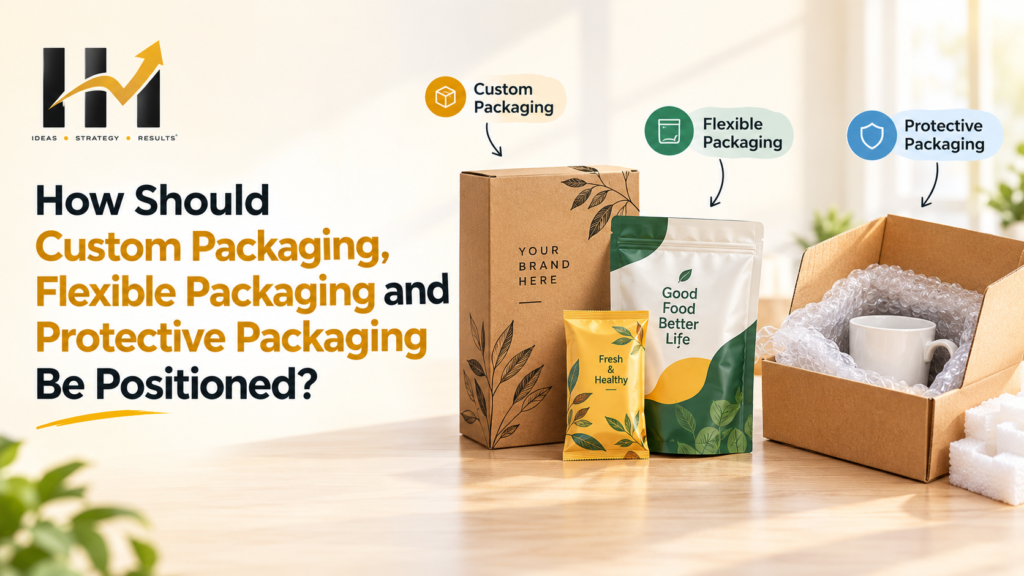
How Should Custom Packaging, Flexible Packaging and Protective Packaging Be Positioned?
Packaging suppliers often offer several categories that serve very different purposes. Treating them all as one generic “packaging material” category can make the website difficult for both users and search engines to understand.
The solution is to position each category according to its product characteristics, application and buyer problem.
Custom packaging
Custom packaging should answer:
- What can be customized?
- Can dimensions be changed?
- Is printing available?
- Can the structure be modified?
- Are inserts available?
- Can samples or prototypes be provided?
- What affects MOQ?
- What affects production time?
A useful process is:
Requirement → Dimensions → Material → Structure → Printing → Sample → Approval → Production → Delivery
The exact process should reflect the supplier’s real workflow.
Flexible packaging
Flexible packaging can include different films, pouches, rolls and laminated structures depending on the supplier.
A detailed page should explain:
- Available formats
- Material types
- Thickness where relevant
- Printing
- Sealing
- Barrier requirements
- Application suitability
- MOQ
- Customization
The page should not make technical claims unless the company can verify them.
Protective packaging
Protective packaging solves a different problem: reducing the risk of damage during storage, handling and transportation.
Depending on the supplier, this could include:
- Bubble wrap
- EPE foam
- Protective sheets
- Corrugated inserts
- Edge protection
- Honeycomb packaging
- Other cushioning materials
Current Ahmedabad supplier results show businesses offering combinations of corrugated boxes, bubble materials, stretch film, foam and related packaging products.
Position products around applications
Instead of only:
“Buy EPE foam.”
consider:
“Protective EPE foam packaging for fragile components.”
The second version explains the relationship between product and use case.
However, application claims should remain accurate. A supplier should not imply that a material is appropriate for an application unless its properties and actual use support that statement.
How Can Product Specifications, MOQ, Materials and Applications Improve B2B Conversion?
B2B buyers often abandon a supplier website when they cannot find basic purchasing information.
Imagine a procurement manager looking for 5,000 customized boxes. They may need to know:
- Can the supplier manufacture the required size?
- What material is available?
- What is the MOQ?
- Is printing possible?
- How long does production take?
- Can samples be provided?
- Does the supplier deliver to the required location?
If the website answers none of these questions, the buyer may move to another supplier.
Make MOQ understandable
MOQ means Minimum Order Quantity.
However, MOQ is not necessarily the same for every product.
It can depend on:
- Material
- Size
- Printing
- Customization
- Production method
- Order quantity
- Supplier capacity
Therefore, avoid publishing a generic MOQ unless it genuinely applies to all relevant products.
Instead:
“MOQ varies by product and customization. Share your required size, material and quantity for an accurate quotation.”
Explain material selection
The website can help buyers understand which factors matter:
Requirement | Factors to consider |
Product protection | Strength/cushioning |
Branding | Printing/surface |
Moisture | Material/barrier characteristics |
Shipping | Size/weight/protection |
Bulk storage | Stackability/space |
Food application | Suitability/compliance |
Export | Transit/environment requirements |
Improve enquiry forms
A generic contact form often creates low-quality leads.
Instead, ask:
- Company name
- Contact person
- Product required
- Dimensions
- Quantity
- Material
- Printing requirement
- Application
- Delivery location
Not every field needs to be mandatory.
The objective is to collect enough information for a sales representative to understand the requirement without creating unnecessary friction.
How Can Packaging Suppliers Use Case Studies and Certifications to Build Trust?
B2B buyers need evidence that a supplier can actually deliver what the website claims.
This is particularly important when the order involves customized packaging, recurring supply, large quantities or industry-specific requirements.
A packaging website saying “best quality,” “trusted supplier” or “premium manufacturer” does not provide much evidence by itself.
Real evidence is more useful.
Show the business, not just stock images
Useful visual evidence can include:
- Manufacturing facility
- Warehouse
- Machines
- Product photographs
- Finished packaging
- Packaging processes
- Quality checks
- Dispatch process
- Team photographs
The images should represent the actual business.
Create genuine case studies
A useful packaging case study could contain:
Client requirement
What type of product needed packaging?
Challenge
What packaging problem existed?
Evaluation
What factors were considered?
Solution
What packaging format/material/design was supplied?
Implementation
How was the packaging produced or supplied?
Outcome
What documented result was achieved?
The final section should contain only verifiable information.
Do not invent claims such as:
“Packaging damage reduced by 47%.”
unless the business has actual records supporting that number.
Certifications should be explained
If the company has certifications, explain:
- Name
- Standard
- Scope
- Issuing body
- Validity where relevant
- Which operations/products the certification applies to
Do not use certification logos in a misleading way.
Demonstrate expertise through useful explanations
A supplier can demonstrate expertise without making exaggerated claims.
For example, instead of:
“We are packaging experts.”
explain:
“Box dimensions, material selection, product weight and transportation conditions can influence the appropriate packaging configuration.”
This is more informative and allows the business to demonstrate knowledge through actual content.
Google’s current guidance emphasizes helpful, reliable, people-first content. Evidence-based supplier information supports both user trust and useful search content.
How Can WhatsApp, Quote Forms and Call Tracking Improve Packaging Lead Quality?
A packaging supplier’s website should make it easy for a potential buyer to start a conversation in the format most suitable for the requirement.
Some buyers want to submit a detailed specification. Others want to send a product photograph through WhatsApp. Others may prefer a phone conversation.
Therefore, a single “Contact Us” button may not be enough.
Quote forms
A quotation form is particularly useful for custom or bulk packaging.
Recommended fields include:
- Name
- Company
- Phone
- Product
- Required quantity
- Dimensions
- Material
- Printing
- Application
- Delivery location
- Additional requirements
A file-upload option can be useful where buyers need to provide a drawing, existing box design or product reference, provided the website supports it.
WhatsApp can be useful for quick B2B communication, especially when a buyer wants to share:
- Product photographs
- Measurements
- Existing packaging
- Drawings
- Quantity requirements
However, WhatsApp enquiries should still be recorded in the sales process if the business wants accurate marketing attribution.
Call tracking
Calls can represent valuable B2B leads, but simply counting every call may produce misleading results.
A better system distinguishes between:
- Missed calls
- Wrong numbers
- Existing customers
- Sales enquiries
- Supplier enquiries
- Qualified opportunities
Track lead quality
A practical funnel is:
Enquiry → Qualified → Quotation → Negotiation → Order
Marketing performance should eventually be connected to these stages.
For example, if SEO generates 50 enquiries but only two are qualified, while another channel generates 15 enquiries and eight are qualified, the raw enquiry count does not tell the full story.
Google Ads provides search-term reporting and search-term insights that can help businesses understand what users are searching for and which search themes generate engagement and conversions.
How Can Sustainable and Eco-Friendly Packaging Content Capture New B2B Demand?
Sustainability is increasingly relevant to packaging discussions, but packaging companies need to avoid vague environmental marketing claims.
Calling a product “100% eco-friendly” without explaining what that means can create confusion.
Packaging sustainability depends on several factors, including:
- Material composition
- Recycled content
- Recyclability
- Reuse
- Product protection
- Manufacturing
- Transportation
- Disposal infrastructure
- Applicable requirements
Create evidence-based sustainability content
Instead of creating a page filled with generic statements, explain measurable or verifiable characteristics.
For example:
- Percentage of recycled content, if documented
- Material composition
- Recyclability information
- Reusable characteristics
- Relevant certifications
- Supplier documentation
- Disposal considerations
Create comparison content
Useful articles could include:
- Paper vs plastic packaging
- Reusable vs single-use packaging
- How to reduce packaging material
- How packaging dimensions affect material usage
- What recyclable packaging means
- How businesses can evaluate packaging sustainability
These topics can attract informational searches while introducing potential customers to the supplier.
Connect sustainability with actual business requirements
A manufacturing company may want to reduce packaging waste.
An e-commerce company may want to reduce unnecessary package size.
A retailer may want packaging that supports branding while using a particular material.
A food business may have specific material requirements.
The content should therefore explain the trade-offs rather than claiming that one material is universally superior.
Avoid sustainability keyword stuffing
Do not create repetitive pages for:
- eco-friendly packaging Ahmedabad
- sustainable packaging Ahmedabad
- green packaging Ahmedabad
- environmentally friendly packaging Ahmedabad
unless each page has a genuinely different purpose.
A single comprehensive sustainability resource can be more useful than several thin pages.
How Should Ahmedabad Packaging Suppliers Measure Enquiries, Quotes and ROI?
Digital marketing becomes considerably more useful when the business can connect marketing activity with actual sales outcomes.
For packaging suppliers, this is particularly important because a lead can have very different commercial values.
One enquiry may be for 100 boxes.
Another may be for recurring industrial supply.
Another may simply be a consumer looking for a single product.
Therefore, the business should track more than website traffic.
SEO measurement
Useful metrics include:
- Organic impressions
- Organic clicks
- CTR
- Search queries
- Landing pages
- Indexed pages
- Organic enquiries
- Qualified organic leads
Search Console can help identify the queries and pages associated with organic search visibility.
Local SEO measurement
Track:
- Business Profile interactions
- Website visits
- Calls
- Direction requests where relevant
- Reviews
- Local enquiries
Remember that local rankings can vary according to the searcher’s location. Google states that local results are influenced by relevance, distance and prominence.
Therefore, “rank #1 in Ahmedabad” should not be treated as a universal or guaranteed metric.
Google Ads measurement
Track:
- Impressions
- Clicks
- CTR
- CPC
- Conversions
- Conversion rate
- Cost per lead
- Qualified leads
- Quotations
- Orders
- Revenue/value where available
Google’s reporting tools allow advertisers to examine campaign performance, search queries and landing pages. Google specifically recommends using search-term information to improve keywords and ads.
Build a complete funnel
A simple example:
Organic search
→ Product page
→ Quote request
→ Qualified lead
→ Quotation
→ Order
The actual conversion numbers will vary by company and should not be treated as industry benchmarks.
The important principle is that the business should identify which channels produce valuable opportunities, not merely which channels produce the most visitors.
How Should a Packaging Supplier Build Its Website Architecture for SEO?
A strong website architecture helps users and search engines understand how the company’s products relate to one another.
Instead of:
Home → Products → Everything
a packaging supplier can build a clearer structure.
Recommended architecture
Home
↓
Packaging Materials
- Corrugated Boxes
- Cardboard Boxes
- Flexible Packaging
- Protective Packaging
- Food Packaging
- Industrial Packaging
↓
Applications
- E-commerce
- Food
- Pharmaceuticals
- Engineering
- Export
- Retail
↓
Resources
- Packaging Guides
- Product Comparisons
- MOQ Guide
- Packaging Specification Guide
- Industry Articles
↓
Contact / Request Quote
This structure creates clear relationships between products, applications and educational content.
Product pages should link to related pages
For example:
Corrugated Boxes
can link to:
- E-commerce Packaging
- Industrial Packaging
- Custom Packaging
- Packaging Material Guide
- Request a Quote
Similarly:
Protective Packaging
can link to:
- Fragile Product Packaging
- Industrial Packaging
- Export Packaging
- Contact/Sales
Avoid orphan pages
A page should ideally be discoverable through the website’s navigation or contextual internal links.
A valuable product page that receives no internal links can be difficult for visitors to discover.
Use descriptive anchor text
Instead of:
“Click here”
use:
“Explore custom corrugated packaging boxes”
when that accurately describes the destination.
Internal linking should help users move through the website, not simply distribute keywords.
How Can Packaging Suppliers Create Content That Supports Both SEO and Sales?
A packaging supplier’s blog should not exist simply because “businesses need blogs.”
Every article should answer a genuine question or help a potential buyer make a packaging decision.
High-value content categories
Product education
- What are corrugated boxes?
- What is the difference between 3-ply and 5-ply packaging?
- How does custom box printing work?
- What is protective packaging?
Buyer education
- How to choose packaging for fragile products
- What should you ask a packaging supplier?
- How to calculate packaging requirements
- What affects packaging cost?
Industry content
- Packaging for e-commerce
- Packaging for food businesses
- Packaging for engineering companies
- Packaging for exporters
Comparison content
- Corrugated vs cardboard packaging
- Flexible vs rigid packaging
- Custom vs standard packaging
Reusable vs single-use packaging
Add commercial pathways
An educational article should not aggressively sell after every paragraph.
Instead, introduce relevant commercial resources naturally.
For example:
“If you already know the box dimensions and quantity you require, you can request a quotation from the supplier.”
Then link to the appropriate quote page.
This is more user-friendly than inserting multiple unrelated CTAs.
Use first-hand business information
The most valuable content can come from the supplier itself:
- Frequently asked sales questions
- Common specification mistakes
- Typical quotation requirements
- Actual product photographs
- Packaging selection process
- Manufacturing insights
- Real case studies
This information can make a page significantly more distinctive than generic AI-generated industry content.
What Are the Most Common Digital Marketing Mistakes Packaging Suppliers Should Avoid?
Packaging businesses often lose potential search visibility or leads because of simple structural problems rather than because they lack products.
Mistake 1: One generic service page
A single page cannot adequately explain every packaging product.
Mistake 2: Keyword stuffing
Repeating “packaging material supplier Ahmedabad” in every paragraph makes the content unnatural and does not solve the buyer’s problem.
Mistake 3: No product specifications
If buyers cannot understand the product, they may leave before contacting the business.
Mistake 4: No clear MOQ information
If MOQ varies, explain what determines it instead of hiding the information.
Mistake 5: Sending every ad to the homepage
A specific search deserves a specific landing page.
Google’s own Ads guidance recommends directing users to relevant destination pages.
Mistake 6: No conversion tracking
Without tracking, the business cannot reliably determine which marketing activity creates enquiries.
Mistake 7: Measuring only traffic
A thousand irrelevant visitors may be less valuable than a smaller number of highly relevant B2B visitors.
Mistake 8: Fake claims
Avoid unsupported statements such as:
- Best supplier
- No. 1 manufacturer
- Lowest price
- Guaranteed delivery
- Guaranteed quality
- 100% eco-friendly
unless the claim can actually be substantiated.
Mistake 9: Duplicate location pages
Changing only the city/area name does not create genuinely useful local content.
Mistake 10: Generic stock images
Actual product and facility photographs can provide stronger evidence of the business when they genuinely represent the company.
Mistake 11: Ignoring existing customers
Marketing should support repeat purchasing and cross-selling as well as new acquisition.
Mistake 12: Publishing unsupported AI-generated content
AI can assist with research and drafting, but every factual business claim should be reviewed before publication.
The goal should always be useful information for the buyer rather than content produced merely to increase page count.
How Can Packaging Suppliers Build a 90-Day Digital Marketing Plan?
A practical implementation schedule can help turn the strategy into measurable work.
Days 1–30: Foundation
First, audit:
- Website
- Product pages
- Google Business Profile
- Search Console
- Analytics
- Existing Google Ads
- Conversion tracking
- Current keyword visibility
- Competitor pages
Then create the keyword-to-page map.
Identify the highest-priority products and applications.
Improve the most important product pages first.
Days 31–60: Content and local visibility
Build:
- Product pages
- Application pages
- FAQ content
- Internal links
- Local business information
- Product photographs
- Case-study content
- Trust information
Update the Business Profile with accurate information and relevant media.
Days 61–90: Paid search and optimization
Launch or restructure Google Ads around actual product categories.
Monitor search terms.
Identify:
- Relevant new searches
- Irrelevant searches
- High-quality enquiries
- Weak landing pages
- Strong converting themes
Google’s Search Terms Report can be used to understand the actual searches triggering ads and identify opportunities for new keywords or negative keywords.
Continue after 90 days
SEO is not a one-time activity.
Continue:
- Updating product pages
- Publishing useful content
- Improving internal links
- Reviewing Search Console
- Reviewing Ads search terms
- Improving conversion rates
- Adding genuine case studies
- Updating outdated information
- Expanding successful product/application pages
The strategy should evolve according to actual customer behaviour rather than a fixed keyword list.
Conclusion
Digital marketing for packaging material suppliers in Ahmedabad should be built around the complete B2B buying journey rather than around keywords alone.
A buyer may begin with a broad search such as “packaging supplies,” move to “cardboard packaging boxes,” compare suppliers, check local availability, review specifications, ask about MOQ, request a quotation and eventually place a bulk order.
The supplier’s digital presence should support every important step.
The strongest framework is:
Search Demand → Relevant Page → Product Information → Specifications → Trust → Enquiry → Qualification → Quotation → Order
SEO creates the foundation for long-term organic visibility.
Local SEO helps communicate genuine geographic relevance.
Google Ads can capture active search demand.
Product pages answer purchasing questions.
Industry-specific pages connect packaging products to business applications.
Case studies and certifications provide evidence.
WhatsApp, forms and calls create convenient conversion paths.
Analytics and CRM data help the business understand which sources produce meaningful opportunities.
For Ahmedabad packaging suppliers, the objective should therefore not simply be to “rank for packaging keywords.”
The more valuable objective is to become a useful and trustworthy digital resource for businesses that need packaging in Packing Material In Ahmedabad, while making it easy for those businesses to move from research to quotation.
That is what turns search visibility into a practical B2B acquisition system.

Frequently Asked Questions
Packaging material suppliers can be found through Google Search, Google Maps/Business Profiles, manufacturer websites, industry directories and local supplier searches. Buyers should compare the supplier's actual product range, specifications, MOQ, customization options, delivery coverage, quality documentation and quotation process rather than choosing solely on search position.
Depending on the supplier, packaging materials can include corrugated boxes, cardboard boxes, flexible packaging, paper packaging, plastic packaging, protective materials, bubble packaging, foam, tapes, stretch film, industrial packaging and export packaging.
Start with your actual requirement: product type, dimensions, quantity, application, protection needs and customization. Then compare suppliers on material specifications, MOQ, quality, samples, production capability, delivery, communication and commercial terms.
Ask about material, dimensions, strength or technical specifications, MOQ, customization, printing, sample availability, production lead time, delivery, payment terms and relevant documentation.
MOQ means Minimum Order Quantity. There is no single MOQ applicable to every packaging product. It may vary according to material, dimensions, printing, customization, production process and order quantity.
Many suppliers offer customization, but the available options depend on the product and manufacturing capabilities. Buyers should confirm whether the supplier can provide the required dimensions, structure, printing, material and quantity.
The answer depends on the food product, intended use, contact requirements, storage conditions and applicable regulations. Buyers should confirm that the specific packaging material is appropriate for their intended food application and request relevant supplier documentation where necessary.